



 239 330

CAMINO DE SANTIAGO, SPAIN
239
January14
O
ne of the world’s great walks
starts wherever you want it
to, and whenever you want
to do it. You can make it as
long as you like, though 100 kilometres
is regarded as a minimum. And if you
complete it in particular years, all your
sins are forgiven – or so the believers say.
This is the Camino de Santiago de
Compostela, a web of trails blazed
across Europe in the Middle Ages by
pilgrims slogging their way towards
the remains of the apostle St James,
interred in the cathedral of Santiago in
northwest Spain.
If you’re looking for a travel experience
beyond a Bali beach break or a guided
package tour, this iconic walk could
be for you. Those who take on the
challenge will join a fascinating mix of
people from all over the world: dedicated
pilgrims on spiritual journeys, retirees
defying the years, Spanish youths who’ll
place the achievement high on their
CVs, fugitives from love gone wrong,
others walking off grief (as portrayed
by Martin Sheen in the 2010 movie
The
Way
), or those who just like the idea of
a long hike through a fascinating culture
and landscape.
Traditionalists start their Camino from
home, simply walking out the front door.
For a few, that start can be as far away
as Germany, Italy or beyond and involve
trudging through snow while crossing
the Pyrenees and other ranges.
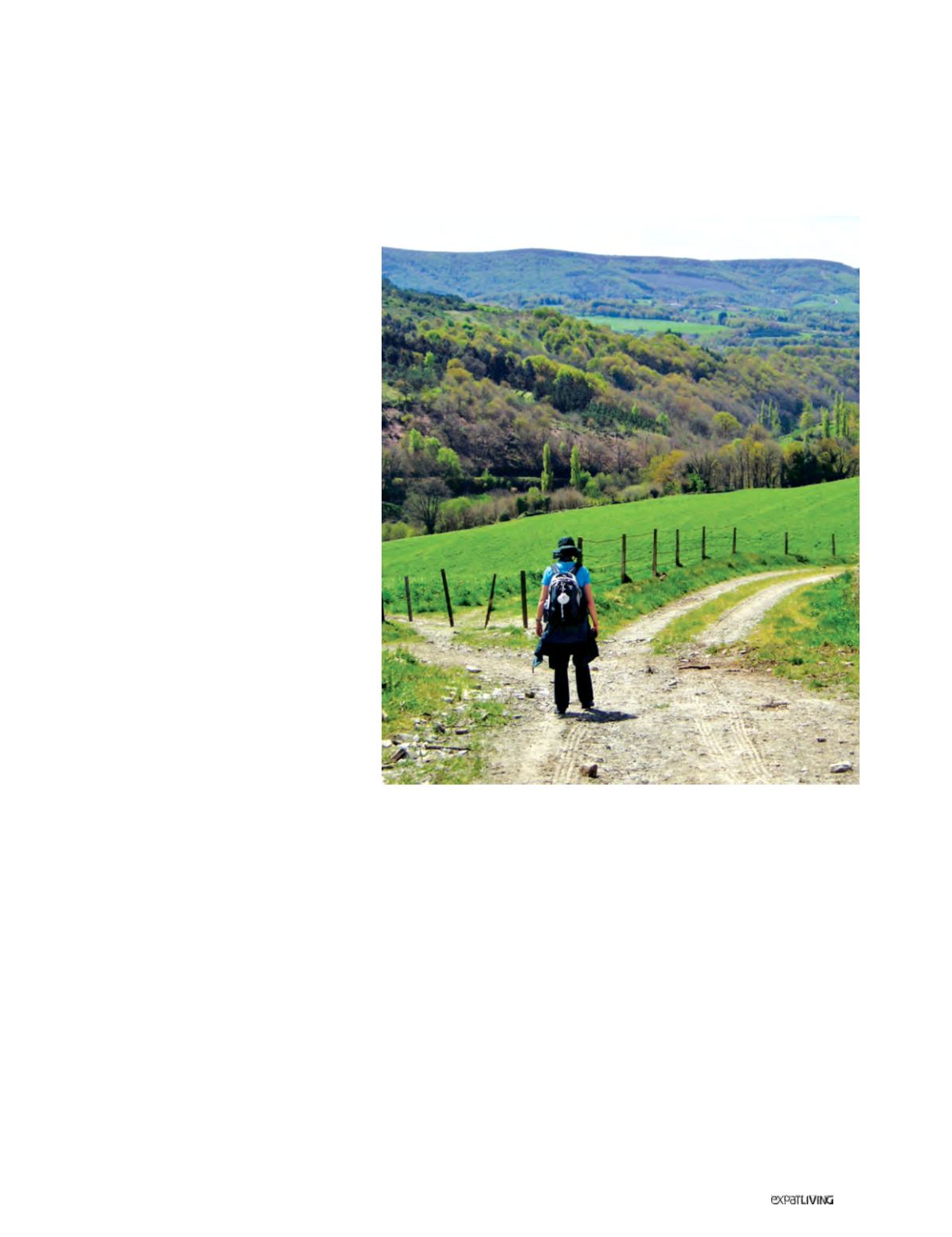
Rebecca and I tackled the Camino’s
route français
across northern Spain,
the path of choice for medieval pilgrims
from France keen to stay clear of
unsympathetic Moors who dominated
southern Spain for much of that
country’s history. We chose April, to
avoid the crowds and heat of summer
and to dodge the cold tail of winter.
We allocated 16 days of 25km for
a total of 400km. The closest starting
point for this distance is the city of León.
There, arriving by train, we posted our
luggage on to Santiago, leaving only
essential needs in the backpacks we’d
tote for the walk. At León Cathedral
we collected our Camino passports,
which were to be stamped at overnight
stops to verify our pilgrim status and
thus earn the coveted “Compostela”
certificate awarded to those who walk
at least 100km (riding a bicycle or horse
requires 200km). Next morning we took
the first steps that begin every journey.
Pre-trip practice tramping around
Singapore streets had taught us just
how critical weight would be. We’d
bought lightweight hiking boots and,
with ruthless inventories, managed to
keep our packs down to about eight
kilos each, not including water.
Like all pilgrims, we displayed a
scallop shell. Traditionally a scoop for
water along the way, the shell’s fluted
grooves converge on a single point
– a metaphor for the journey. Like all
pilgrims, we greeted fellow travellers with
“
Buen Camino
”.
Along the route are
refugios
, basic
dormitories maintained for pilgrims
bearing the Camino passport and
charging a token tariff for overnight
unisex accommodation, with tiered
bunks, blankets (no sheets, so we
carried silk liners) and showers.
Every pilgrim should try a
refugio
as part of the experience. In the
warmer months they can be full by mid-
afternoon, though, so it’s sensible to
have the option of one of the
pensiones
along the way – a blessed break from
snoring neighbours, stinky socks and
bathroom queues.
Then there’s the walking: a serious
distance with a relentless rhythm, along
paths, roads and bridges, across plains,